



Understanding a Certificate of Analysis
Click each marker to learn what the test or report information means.

A
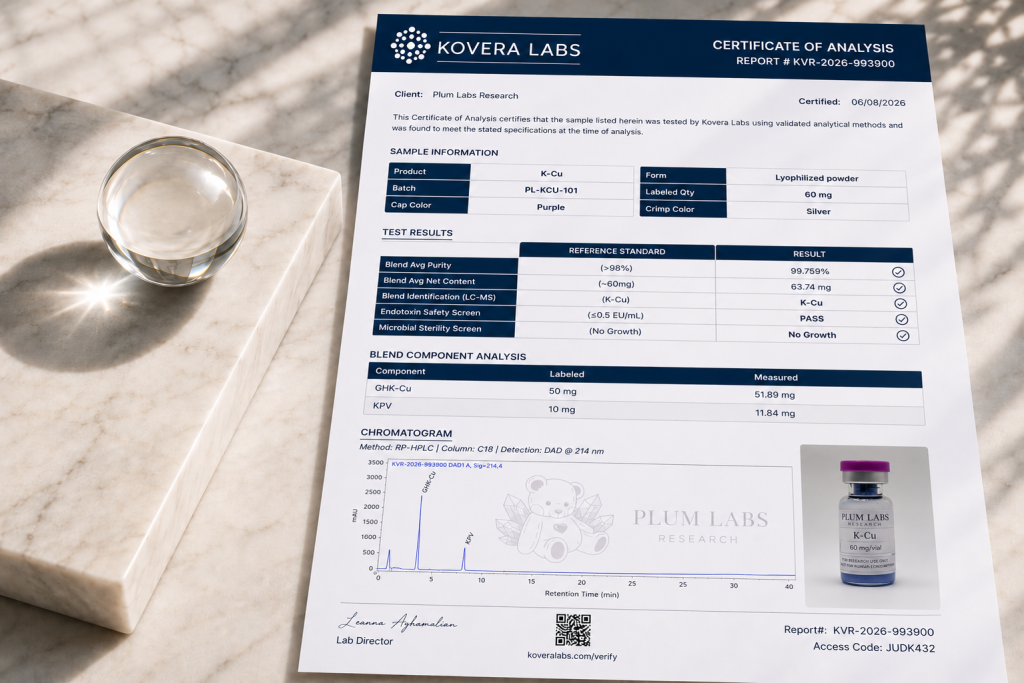
Product
Product identifies the compound or material submitted to the laboratory for testing.
Product: Adamax (1032)
This tells you what sample the laboratory report is associated with.
B
Form
Form describes the physical form of the sample that was submitted to the laboratory.
Form: Lyophilized Powder
Lyophilized means the sample was provided in a freeze-dried form.
C
Batch
Batch identifies the specific batch or lot associated with the sample submitted for testing.
Batch: PLR-AX-J101
The batch identifier helps connect the laboratory report to the corresponding batch of product.
D
Labeled Quantity
Labeled Quantity is the amount stated on the submitted sample's label.
Labeled Quantity: 10 mg
This is not the laboratory's measured Net Content result.
E
Cap Color
Cap Color records the color of the cap on the submitted sample.
Cap Color: Purple
F
Crimp Color
Crimp Color records the color of the vial's crimp or seal.
Crimp Color: Silver
1
Purity
Purity tells you how much of the detected material corresponds to the primary compound compared with other detectable components in the chromatographic analysis.
Reference Standard: >98%
Result: 99.659% ✓
Purity does not tell you how many milligrams are present. Net Content measures that separately.
2
Net Content
Net Content tells you how much compound was actually measured in the tested vial.
Labeled Quantity: 10 mg
Batch Average: 10.49 mg ✓
3
Identification
Identity testing checks whether the compound detected by the laboratory matches the compound the sample is expected to contain.
Method: LC-MS
Expected: Adamax (1032)
Result: Adamax (1032) ✓
4
Endotoxin
Endotoxin screening evaluates the sample against the laboratory's stated endotoxin specification.
Reference Standard: ≤0.5 EU/mL
Result: PASS ✓
5
Sterility
The microbial sterility screen looks for microbial growth under the laboratory's testing conditions.
Reference Standard: No Growth
Result: No Growth ✓
6
Heavy Metals
Heavy metal screening checks the sample for the metals listed in the laboratory report.
Arsenic: Negative ✓
Cadmium: Negative ✓
Lead: Negative ✓
Mercury: Negative ✓
7
Batch Conformity
Batch Conformity compares results from multiple sampled vials from the same batch.
Vial 1: 99.544% / 10.48 mg
Vial 2: 99.564% / 10.24 mg
Vial 3: 99.869% / 10.76 mg
Batch Average: 99.659% / 10.49 mg
G
What is a Chromatogram?
A chromatogram is the visual output produced during chromatographic analysis. The peaks represent components detected as the sample passes through the analytical system.
Method: RP-HPLC
Column: C18
Detection: DAD @ 214 nm
H
Report Number
The Report Number identifies this laboratory report and can be used to look up the Certificate of Analysis through Kovera Labs.
Report Number: KVR-2026-E388B8
Understanding a Certificate of Analysis
Choose an item from the guide or tap a marker directly on the report.
COA Guide ⌄
Select a marker
Choose an item from the COA Guide above or tap a marker directly on the report.
Purity
Purity tells you how much of the detected material corresponds to the primary compound compared with other detectable components in the chromatographic analysis.
Reference Standard: >98%
Result: 99.659% ✓
Purity does not tell you how many milligrams are present. Net Content measures that separately.
Net Content
Net Content tells you how much compound was actually measured in the tested vial.
Labeled Quantity: 10 mg
Batch Average: 10.49 mg ✓
Identification
Identity testing checks whether the compound detected by the laboratory matches the compound the sample is expected to contain.
Method: LC-MS
Expected: Adamax (1032)
Result: Adamax (1032) ✓
Endotoxin
Endotoxin screening evaluates the sample against the laboratory's stated endotoxin specification.
Reference Standard: ≤0.5 EU/mL
Result: PASS ✓
Sterility
The microbial sterility screen looks for microbial growth under the laboratory's testing conditions.
Reference Standard: No Growth
Result: No Growth ✓
Heavy Metals
Heavy metal screening checks the sample for the metals listed in the laboratory report.
Arsenic: Negative ✓
Cadmium: Negative ✓
Lead: Negative ✓
Mercury: Negative ✓
Batch Conformity
Batch Conformity compares results from multiple sampled vials from the same batch.
Vial 1: 99.544% / 10.48 mg
Vial 2: 99.564% / 10.24 mg
Vial 3: 99.869% / 10.76 mg
Batch Average: 99.659% / 10.49 mg
Product
Product identifies the compound or material submitted to the laboratory for testing.
Product: Adamax (1032)
Form
Form describes the physical form of the sample that was submitted to the laboratory.
Form: Lyophilized Powder
Lyophilized means the sample was provided in a freeze-dried form.
Batch
Batch identifies the specific batch or lot associated with the submitted sample.
Batch: PLR-AX-J101
Labeled Quantity
Labeled Quantity is the amount stated on the submitted sample's label.
Labeled Quantity: 10 mg
This is different from the laboratory's measured Net Content result.
Cap Color
Cap Color records the color of the cap on the submitted sample.
Cap Color: Purple
Crimp Color
Crimp Color records the color of the vial's crimp or seal.
Crimp Color: Silver
Chromatogram
A chromatogram is the visual output produced during chromatographic analysis. Its peaks represent components detected as the sample passes through the analytical system.
Method: RP-HPLC
Column: C18
Detection: DAD @ 214 nm
Report Number
The Report Number identifies this laboratory report and can be used to look up the Certificate of Analysis through Kovera Labs.
Report Number: KVR-2026-E388B8
Visit koveralabs.com/verify and enter the Report Number shown on the report.